
Module 2
Lecture Notes - Part 1b
Learning Objectives: How
A. Process of Writing Learning Objectives
The biggest challenge when drafting learning objectives is ensuring that they
represent specific competencies and can be directly linked to equally specific
learning activities that will help achieve these competencies. As previously
mentioned, one may think of learning objectives as guidelines that
i) outline everything you would like students to know by the end of a course or
course module and ii) could offer another instructor enough direction to
actually teach your course/course module in your place.
Steps leading to the creation of learning objectives and assignments
(adapted from Wiggins and McTighe, 2005)
- Consult standards (national, state, and program/departmental)
- Establish program goals
- Determine which program goals are to be addressed in a given course
- Determine essential questions for your course and decide what broad concepts must be addressed
- Determine the knowledge and skills required to support student understanding of the course's core concepts (i.e. course learning objectives)
- Determine the type(s) of assignments that students will tackle to achieve and demonstrate mastery of the learning objectives
Steps 1-3 are beyond the scope of DOTS.
Essential questions are the questions that students should be able to answer by the end
of your course. They must address core processes of the discipline; big ideas
that
encompass the facts, skills, and activities in your course and support
enduring understanding.
Imagine, for example, that you were giving a comprehensive final
exam. What essential broad concepts would you assess?
Beyond “topics worth covering," enduring understanding involves focus on
learning goals that support development of knowledge and skills with value beyond the classroom.
You can identify such goals by answering the following questions:
- To what extent does an idea, topic, or process reside at the heart of the discipline represented by the course?
- What learning activities/questions point towards the big ideas and understandings?
- What arguable, controversial questions deepen inquiry and discussion?
- What questions provide a broader intellectual focus and therefore purpose to the course?
Examples of essential questions
- "When measurement error is unavoidable, what error margins are tolerable?"
- "Is there a connection between a country’s form of government and the prosperity of its citizens?"
- "What is the relationship among strong opinions, intuition, scientific facts, and scientific theories?"
The essential questions you produce will help you focus on what is most important in your course and what students must take out of it. The learning objectives of a course represent the knowledge and skills that will help students successfully address the course's essential questions.
Measurable demonstration of student knowledge and understanding will be accomplished through participation in high-stakes (i.e. graded) learning activities. The term "assignments" is used in DOTS to describe such activities. We will be addressing assignment-design later on in this module.
B. Mechanics of Writing Learning Objectives: The ABCD Method
An effective learning objective describes an intended instructional outcome,
reveals the purpose of the instruction, and inhibits misinterpretation.
The ABCD method of writing learning objectives, originally presented in Heinich et al.
(1996), outlines four features through which an
objective may successfully communicate an instructional intent: Audience,
Behavior, Condition, and Degree.
| Audience | Who will be performing the learning objective? (i.e. level/background/age of students) Audience and the concept of entering behaviors
|
| Behavior | What knowledge- and skill-acquisition will the students be demonstrating?
(i.e. activities that will help students acquire and demonstrate knowledge/skills; a list of what students should be able to do, know, and care about once the objective has been accomplished)
|
| Condition | What resources do students need to succeed in the expected behavior? (i.e. academic, technology, and interaction resources)
|
| Degree | What degree of knowledge and skill acquisition is expected?
|
C. Examples of Learning Objectives and an "Objectives Builder"
Examples of well-structured learning objectives
Q: Which of the four features (i.e. Audience, Behavior,
Condition, and Degree) is absolutely
necessary to a
successful learning objective?
A: Behavior
Note: The action verbs in the examples below appear in the gerund form to avoid repeating the implied "Students will be able to ..." at the beginning of each statement. Alternatively, these verbs can appear in the imperative form, as is the case with most DOTS objectives.
With the A feature (i.e. "Students will be able to ...") removed, can you identify the B, C, and D features in each objective?
- Indentifying the differences among the three principal subatomic particles
- Comparing and contrasting the Civil War causes presented in the literature
- Identifying the key differences between classical and operational conditioning through analysis of case studies
- Identifying the most salient facts, stakeholders, consequences, duties, underlying values, and relationships in a given ethical case study
- Defining cognitive maps and uncovering their underlying biases
- Describing and applying to case studies the major provisions
in APA’s code of ethics for research with human and animal
subjects
You can read more examples created by the Research on Teaching, Learning, and Technology group, Penn State University.
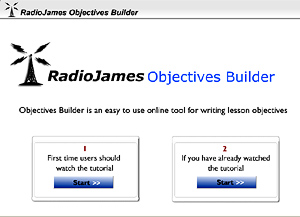
Web-based Learning Objectives Builder
|
Learning Objectives Builder |
Use this Web-based tool to experiment with various combinations of the learning-objectives features discussed. To make the most of the tool, it is recommended you first watch the provided tutorial. The tutorial is in Flash format and includes 7 narrated slides: |
Return to Part 1a - Learning Objectives: What and Why