Fundamentals of Sound
MODULE 8: SOUND ENVIRONMENT
ARCHITECTURAL ACOUSTICS


Perceptual attributes of acoustic waves

IMPACT OF THE SOUND ENVIRONMENT

Perceptual criteria for room acoustics
Acoustical and room construction / layout correlates - Architectural Acoustics

 Introduction - Definitions
      Reflection / Absorption / Reverberation / Diffusion Criteria
         Warmth -  Brilliance - "Liveness" - Clarity - Intimacy - Uniformity - Smoothness
      Multidimensional Criteria
         Spaciousness - Freedom from noise - Performer satisfaction
      Caveats
 Small Room Acoustics


Introduction - Definitions


Main Resources

Additional Resources

  • Auditorium Acoustics and Architectural Design (2nd ed.) (book .pdf)
    Barron, M. (2009). Auditorium Acoustics and Architectural Design (2nd Ed.). Spon Press (Routledge). Oxfordshire, UK.
    On-line (.pdf) version, exploring the acoustical characteristics of music performance spaces. Supported by over 40 detailed case studies and architectural drawings of 75 auditoria (1:500 scale). Each survey includes a discussion of current best practices for optimum acoustics.
     

  • Concert Hall Acoustics
    Links to relevant resources. Part of akutek.info, an acoustics website by M Skålevik of Brekke & Strand Akustikk, Norway.


Key Sound-Modifying Parameters of Enclosed Spaces

The environment in which sound waves are produced (e.g. rooms and other enclosed spaces) modifies the sounds that are heard or recorded. Different types of rooms will impose different types of modifications, with no single room-type being able to provide appropriate listening context to all types of stimuli and listening. Watch: How architecture impacts music (TED talk by American musician and author, David Byrne).
Key parameters include:

•  Overall room size and shape
•  Shape/texture of the reflecting surfaces
•  Location of critical reflecting surfaces relative to a sound source and the listeners, and
•  Absorption characteristics of the reflecting surface materials

Signal-Portions Reaching Listeners in Enclosed Spaces 

Direct Sound

The sound-wave traveling from source to listener (or microphone) on a straight line follows the shortest possible path, arrives first, and constitutes the direct-sound portion of the perceived sound. Unless it encounters obstacles within the space, direct sound is almost identical to the sound emanating from the source. It is followed shortly by several reflected waves from the space's boundaries (walls/floor/ceiling).
   The distance traveled for each reflecting path determines the delay:
       a) between reflections and the original/direct sound &
       b) among reflections. 

First/Early Reflections

Reflections arriving within ~40-100 ms after the direct sound-wave qualify as early reflections
Early reflections occurring within up to ~20ms from each other are perceived as a unified acoustical event.

  • Early reflections with delays <~40ms (<~14m/45ft path difference between direct sound and early reflections) contribute to the overall perceived loudness and sense of spaciousness. If their level is comparable to the level of the direct sound they may "muddy/blur" the perception of the direct sound's attack portion, particularly for impulse signals.

  • Early reflections with delays >~50ms (>~17m/56ft path difference) may be perceived as distinct echoes (if their level is within 10dB from the direct sound) and are to be avoided in listening environments designed for musical performances.

For more, click here.

Late/Diffused Reflections - Reverberation

Following early reflection events, we continue to receive reflected sound waves from increasingly numerous and varied multiple-reflection paths. As the number of reflections increases, contributions get weaker and reach listeners at slightly different times, merging in a diffused and continuously decaying reverberant sound. This contribution is perceived as a loudness increase, timbral smoothing, signal stretching out, and gradual decay of the original acoustic event.

For a sustained sound wave (e.g. bowed string), reflections build up for some time after the arrival of the direct sound wave. The combined sound approaches a steady intensity level after a time sufficient for many reflected waves to arrive and die out.
When a sound-source stops emitting, the direct sound stops first. For the reverberant sound to die out, it takes approximately as long as it took for it to build up.


Warmth - Brilliance - "Liveness" - Clarity - Intimacy - Uniformity - Smoothness

Perceptual Criteria related to Reflection, Absorption, Reverberation, & Diffusion


Warmth - Brilliance - Liveness

Reverberation is the perceptual manifestation of the way sound energy reflects and decays within an enclosed space.

Reverberation depends on the size of the room and on the absorption/reflection characteristics of the walls, ceiling, and floor.
Strong reflections at low frequencies are responsible for warmth, and at high frequencies for brilliance.

Although it is hard to influence the reflection of low frequencies it is possible to modify that of high frequencies and thus change the balance between ‘warmth’ and ‘brilliance.’ For example, placing carpets/curtains (or other soft/pliable materials) on the floor, ceiling, and/or walls, as well as filling up a room with people (or anything that increases the total surface and irregularity of a room) increases the absorption and diffused spread of high frequency energy substantially more than of low frequency energy.

  • Listening spaces with equal or almost equal reverb time at all frequencies are classified as "bright" or "brilliant". 
    Long reverbs with excessive high frequency energy may be classified overly bright or "screechy."

  • Increasing the relative reverb time of lower frequencies (<~500Hz) increases the sense of warmth. 
    Overly long low-frequency reverb times are perceived as "muddiness." 

  • In general, reverb time is usually a little longer for frequencies below 500Hz and most highly-regarded concert halls are classified as 'warm.'

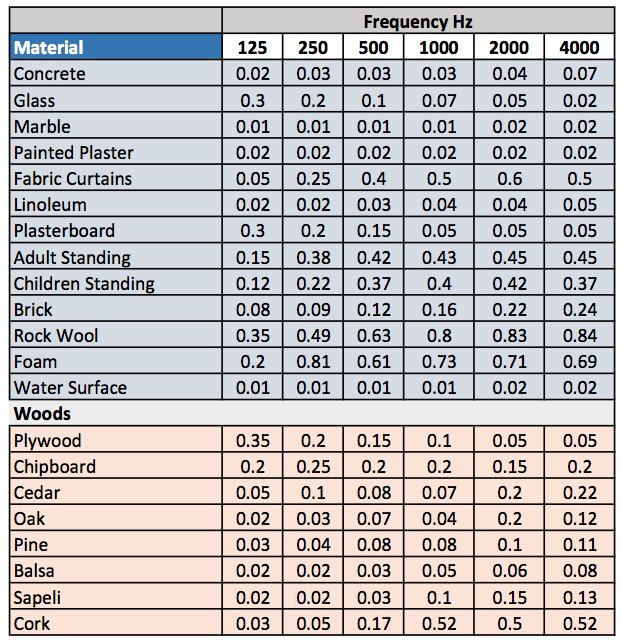
The absorption coefficient, α, of a surface material is defined as the ratio of absorbed (i.e. incident minus reflected) intensity over incident intensity.

Absorption unit: 1 Sabine; named after 19th/20th century American physicist, Wallace Sabine, widely recognized as the founder of the field of Architectural Acoustics. 1 Sabine provides the absorption of a 1m2 surface of a perfectly absorbing material (i.e. a=1). Placing this hypothetical material on a wall would be equivalent to creating an opening of the same size.

Absorption coefficients - α - for some common materials.

Notes
     a) the absorption coefficient of a given material is different at different frequencies and
     b) absorption may increase or decrease with frequency, depending on the material in question.

Standard absorption measurements rate the absorption behavior of materials at the 6 frequencies shown on the table.
In general:
     a) porous materials are high-frequency absorbers
     b) flat, smooth, non porous materials and membranes can be low frequency absorbers, depending on the relationship among
         their mass, thickness, and elasticity.
     c) cavities (e.g. Helmholtz resonators) can be narrow-band absorbers, depending on their dimension, shape, and materials.
For more, click here.

A room's liveness or reverberance is characterized by the reverberation time of primarily the high and middle frequency ranges and is mainly determined by a room's volume and effective surface area.
[Effective surface area: the sum of all surface areas multiplied by their respective absorption coefficients.]

Reverberance can be altered by changing the area and nature of absorbing materials that cover a room's surfaces, and its suitability depends on the type of sound/music in the room. A room with too short a reverb time may be classified as "dry" or "dead"  for a particular type of music, while one that is too "alive" or has too long a reverb time may be called "muddy" or "watery" for another.

Reverberation increases the overall loudness and effective duration of a sound. 

The contribution of reverberation to loudness is objectively measured in terms of the sound pressure level 10m from the sound source within a listening space, relative to the sound level of the same source at the same distance in a free field (or in an anechoic chamber). Similarly to absorption, the contribution of reverberation to loudness is frequency-dependent, with the contribution at middle frequencies being the most important perceptually (why?). 
Reverberation-related loudness is inversely proportional to the total surface-area absorption in a space.

Artificial reverberation must have appropriate loudness relative to the original sound and smooth rates of attack and decay.

Clarity - Intimacy

The clarity criterion (occasionally contrasted to 'fullness') states that each note should arrive to the listeners cleanly, crisply, and unobstructed, unless ‘obstruction’ is desirable (as, for example, in recording a musical event where room contributions or audience reactions are important to the resulting sound).  

The clarity criterion is especially important if a room is used for speech as well as music, because the intelligibility of words depends directly on clarity of articulation. Clarity is sacrificed in rooms with a lot of diffused reflections, a result that may be desirable for certain types of music (e.g. it may enhance slow passages of music from the romantic era).

Clarity is measured in terms of direct-to-reverberant sound intensity ratio and can therefore be increased by increasing the level of the direct sound and/or decreasing the level of the reverberant sound.
Strong and unobstructed direct sound can be achieved by
     a) getting all listeners (including microphones) as close to the sound sources (e.g. the stage) as possible;
     b) installing a raised, raked stage; and
     c) placing the audience on a sloped surface and/or in balconies.
If every listener has a good, unobstructed sight-line, the acoustical clarity will, likely, also be good.

The greatest clarity can only be achieved by sacrificing reverberation. High reverberation results in rooms being perceived as "full" but, in the case of spoken word or fast, highly articulated musical passages, being perceived as unclear or "undefined."

Related to the perceptual criterion of clarity is the sense of intimacy, portrayed when listeners are located closely to the sound source in a small performance space (<~2000sq.ft). The time between the arrival of the direct sound and the first reflection determines the listeners' perceived proximity to the performers.  An intimate feeling occurs when the time delay between direct sound and first reflections is <~20ms.
  

Uniformity (Balance & Blend)

The uniformity criterion states that listeners in all parts of a room should hear as nearly the same sound as possible; there should be no dead spots (i.e. no areas where no or almost no sound arrives) or areas with distinct spectral and therefore timbral coloring.  Instead, there should be uniform spatial distribution of both direct and reflected sound energy throughout the audience, at all frequencies.

Features that promote sonic uniformity

  • For direct sound: Distance minimization between first and last rows (e.g. auditoriums with a shallow hall and several balconies).

  • For reflected sound: Inclusion of diffusion features (e.g. reflective surfaces of varied shape, size, profile, and orientation). 

Features that harm sonic uniformity

  • Poorly positioned concave surfaces (properly designed concave surfaces can be desirable behind a stage), which focus rather then diffuse sound, and/or rectangular rooms with plain flat walls, which facilitate standing waves and enhance level and spectral non-uniformity. Can be partially remedied by increasing the surfaces' absorption and diffusion capabilities.

  • Physical obstructions and/or balcony cavities, which create "dead" spots or sonic "shadows."  Can be partially remedied through the use of fill-in loudspeakers.

Sound signals coming from different locations on the stage should have balanced intensities and be well blended
Issues of sonic balance and blend are common for seats close to a wide stage and may be partially corrected by a low, irregularly shaped ceiling and appropriate onstage reflecting surfaces.

Sound is more thoroughly mixed and distributed over rooms that have irregular shape, nonparallel walls, convex surfaces, many protruding edges and no major obstructions/cavities. There should be small-, medium-, and large-scale structures, each one helping diffuse sounds with wavelengths comparable to the structures' size.

Perfect sonic uniformity is not achievable. Listening spaces, sound amplification set-ups, and loudspeaker system design and deployment are usually rated in terms of minimum achievable or maximum permitted level and spectral variance within the space. These terms do not refer to universal, fixed numerical values. Rather, they represent application-specific limits and design principles that depend on the context of the system or standard being referenced.

Smoothness (freedom from echo)

The smoothness criterion (also referred to as 'freedom from echo') states that, even though there will be repeated sound reflections off walls, none of them should be perceived as a separate echo; all reflections must blend together and die away smoothly with time.

Poorly placed concave surfaces or large, flat, hard surfaces may provide particularly strong reflections, more than 100ms after the direct sound (depending on room size). Such reflections are perceived as a distinct echo, which is usually undesirable. If the reflected sound level is strong enough, even delays as short as ~30-40ms can result in an unpleasant, rough perception. 

To facilitate smooth, blending reflections, successive time gaps between them must be kept under 30ms (time gaps between ~ 5 and 15ms contribute to a feeling of intimacy). Since sound travels at ~0.34 m/ms, the first reflection path for every seat in a room should be <~11m (~35ft) longer than the direct path. This can be facilitated by careful placement of reflecting panels toward the front of an auditorium and the inclusion of sound diffusers of different sizes.


Spaciousness - Freedom from noise - Performer satisfaction

Multidimensional Criteria


Spaciousness

The spaciousness criterion refers to auditory impressions of space and has two perceptual dimensions:

  • Listener Envelopment (LE) describes the impression of being ‘bathed’ in sound from all sides.

  • Auditory Source Width (ASW) describes how wide the sound source appears to the listener.

For effective LE and large ASW, early reflections should arrive not just from the front or back walls, but also from the ceiling and especially the sidewalls. Preferably, the sides and ceiling should not be completely leveled but should include enough level variation to provide several different early reflections, surrounding the listener with sound.
The distinction between ASW and LE depends on the arrival time of lateral reflections. Early lateral reflections (within 80 ms of the direct sound) seem to affect ASW, while late lateral reflections (after 80 ms of the direct sound) seem to affect LE.

Not all types of music require the same degree of LE.
For example, organ music requires an extreme sense of envelopment, assisted by (occasionally inactive) pipes being placed above, behind, or to the side of the audience to mask the origin of the sound source. For other types of music, too much envelopment may be undesirable, as it can blur the aural image of the stage.

Freedom from background noise

The freedom from background noise criterion states that soft passages in the music should not be disturbed by noise outside or inside the auditorium (unless such ‘noise’ is desirable).

Background noise may stem from a variety of sources such as the heating, ventilation, HVAC, and other systems in the room, the audience, exterior sources such as traffic noise, or from some sort of activity in neighboring spaces.
Calculation of background noise can be based on one of many available noise criteria methods and involves a) measuring the sound noise levels in octave bands across a certain frequency range and b) comparing them to a series of 'accepted' noise-level curves.

Substantial construction, double doors, and various sound insulating treatments are common techniques for keeping unwanted sounds from entering a performance space. Total background noise >45dB (with no audience present) makes a room unsatisfactory for musical performances that explore a relatively wide dynamic range. Noise levels of ~30dB are considered acceptable. Any standard <~20dB is difficult to achieve and of little noticeable benefit.

Performer satisfaction

The performer satisfaction criterion states that the stage must be free from distracting echoes and at the same time provide enough enclosure for performers in a group to feel that they are in good communication with one another.

A single strong echo from the wall behind the performers is generally undesirable. A blend of many reflections should return to the stage, strong enough and with uniform, short decay (shorter than the shortest distance between notes), to give the performers some sense of what the audience is listening. 
A good stage usually has a more-or-less shell-type shape to enable the members of a group to hear one another as well as to help project the sound out to the audience. 
The stage should not have hard, parallel sidewalls, which may cause flutter echo (i.e. a sharp percussive tone bouncing back and forth repeatedly). Flutter echo also indicates that part of the sound energy is trapped on stage, not reaching its intended audience.
Ensembles in which members are separated by more than approximately 5 meters may easily lose synchronicity and usually need visual cues (e.g. a conductor) to remain playing in time.


CAVEATS

The majority of the presented criteria are most important when we rely on the natural acoustics of an auditorium

Many musical and other sonic events depend on powerful electronic amplification and levels that exceed ~100dB SPL to create their characteristic sound. They are able to do so in a wide variety of rooms that would be entirely unsatisfactory for non-amplified sound by essentially overpowering the room. Nevertheless, the discussed issues of reflection, absorption, reverberation, and diffusion remain.

All criteria represent general guidelines. Specific goals may differ, depending on the kind of sound/music to be listened to and/or recorded. 

One example is the desired mix of direct sound, early reflections, and reverberation.  Speech is at one extreme; clarity is the overriding criterion and very little reverberation is desired.  At the other extreme, certain pieces for pipe organ call for a sound so full that the reverberation level may even outweigh the direct sound and with reverb time that far exceeds the time-gap between successive sonic events.

The majority of enclosed spaces in which we record sound do not meet most of the criteria discussed.

This means that the position of microphones relative to the sound sources will greatly influence the quality of the recorded sound.


Small Room Acoustics


(Resources by Dr. Milicevic - large files with embedded videos)


Loyola Marymount University - School of Film & Television